

Ownership is one of the greatest promises of Web3. You are the owner of your property. You own your data. Your online reputation is yours to control.
But for years, there was an odd lack of cohesion in identity. A user might have a wallet for DeFi, a wallet for NFTs, a social profile, and several credentials on various applications. Each platform had some information about the user, but none had the full picture.
This is beginning to change.
Many are calling it the “portable identity layer” for Web3, and that is exactly what A new generation of identity projects is developing. It’s as simple as it seems: develop a digital identity that can be shared between apps, blockchains, games, marketplaces, social platforms, and financial services without players having to build from scratch every time.
With the rise of AI agents, decentralized social networks, and onchain economies, portable identity is one of the most critical infrastructure categories in crypto.
If you’re looking for ideas to help bring that future to reality, here are ten projects that can help.
Ethereum Name Service (ENS)
Portable identity is likely the household name in Web3, if it were.
It started as a naming service, and it has become one of the most popular identity layers in crypto. Usernames like “alex.eth” will be used by hundreds of decentralized applications, replacing the need for long wallet addresses.
Based on the industry research conducted in 2026, ENS has already registered over 8 million names and is used in over 340 Web3 applications. ENS names are increasingly being used as usernames, payment identifiers, social profiles, and reputation anchors on several chains.
It’s portable, and that’s the strength of ENS. A single ID can track users across the board.
Lens Protocol
Lens Protocol is trying to solve another problem: social identity.
Lens does not allow platforms to own a social graph, instead, it lets users own their own profiles, followers, content relationships, and reputation. That means that a person can switch between applications without having to abandon the social connections they have developed.
Since its launch, Lens has become one of the biggest decentralized social ecosystems in Web3, handling millions of interactions month after month and allowing users to have their digital identity registered in various applications.
Lens is seeking to be the Web3 version of LinkedIn, Instagram, and X.
Farcaster
Farcaster takes an approach to identity from a social networking standpoint.
With the protocol, users can seamlessly access different social applications running on the Farcaster ecosystem without losing their identity. Profiles, follower relationships, and social reputation still aren’t tied to a single platform.
Portability becomes a growing concern with the expansion of decentralized social networks and diversification. According to industry reports, Farcaster is still one of the largest decentralized social identity ecosystems in existence to date.
World ID
World ID has emerged as one of the most debated and controversial identity projects in crypto.
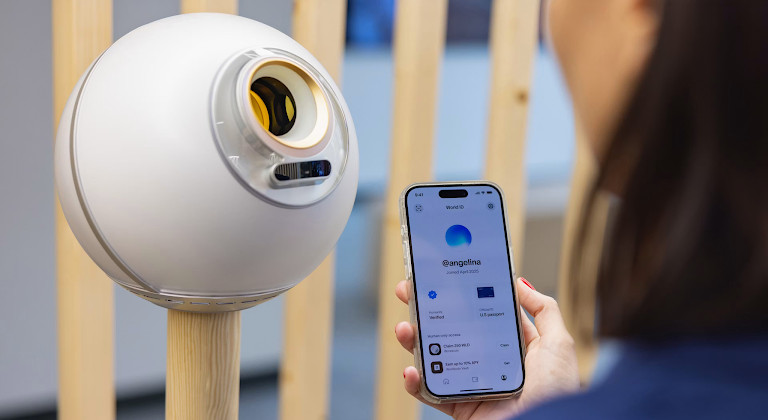
The project is part of the World, and its main concern is proof-of-personhood. World ID’s goal is not to identify whether a given wallet has been used before, but rather to confirm whether the user is a real person.
The system has reportedly issued over 10 million proof-of-personhood credentials worldwide, establishing it as one of the biggest identity networks in Web3.
It is regarded as a remedy to bots and Sybil attacks by supporters. The biometric approach is still under debate. Whatever the case may be, its impact on the identity sector is unarguable.
Privado ID
Privado ID was formerly named Polygon ID and is now one of the top privacy-focused identity frameworks in Web3.
The major benefit of it is the use of zero-knowledge proofs. Specific attributes, like age, residency, KYC status, etc., can be verified by the user without revealing any underlying information to the user ID.
This establishes a mobile ID model with users self-authenticating once and utilizing credentials many different times across applications and blockchain networks. Privado ID is often referred to as one of the most mature decentralized identity systems currently in existence.
Ethereum Attestation Service (EAS)
EAS is not always talked about in tandem with identity projects, but it’s becoming a pivotal aspect of Web3’s identity infrastructure.
Applications and organizations can create verifiable attestations about users on the platform. They might be related to governance participation, education, qualifications, community involvement, checks, etc.
Studies have revealed millions of attestations already generated with EAS, contributing to the development of portable reputations that can be transferred across applications.
It’s like a decentralized reference system for the Internet.
Lit Protocol
Lit Protocol is centered around identity and access control.
Instead of just checking who they are, they will help determine what they are permitted to access based on credentials, ownership, membership, or reputation.
Its decentralized key management system allows users to move permissions and access rights with them (identity-based) across applications. As more and more sophisticated user experiences are developed in Web3 apps, this becomes more and more crucial.
Verida
Verida is developing a more decentralized personal data network.
Users can keep credentials, health details, personal data, social data, and identity data within their control and can be shared as they see fit.
User data is not stored in applications, but users can transport their data from one platform to another with Verida. The idea is very much in line with the idea of self-sovereign identity.
Many privacy advocates view that as a very salient use case of Web3.
Humanity Protocol
Humanity Protocol has become a key player in proof-of-humanity.
The project is based on the technology of palm identification with the support of blockchain verification, which allows for forming individual human identities. The idea is to enable users to claim that they are real humans without compromising on privacy, as in conventional login systems.
It garnered lots of interest once it hit $1 billion in valuation and had hundreds of thousands of early signups.
With the rise of more sophisticated AI-generated accounts and bots, it may become more crucial than ever to implement proof-of-humanity systems.
Space ID
Space ID is about cross-chain identity infrastructure.
The platform enables the user to build a blockchain ID that functions on different ecosystems, and not just on one network. It is like ENS, to make the experience of being represented online as easy and intuitive as possible, and to make it more interoperable.
With the rise of Web3’s multi-chain environment, seamless identity systems that can switch chains may evolve into the backbone of the Web3 infrastructure.
Why Portable Identity Matters
The Web3 future will not be defined by individual applications.
Users will navigate through social networks, financial platforms, games, AI services, marketplaces, and virtual environments. If identity is still broken, so is the user experience as well.
Various projects such as ENS, Lens, Farcaster, World ID, Privado ID, EAS, Lit Protocol, Verida, Humanity Protocol, and Space ID are trying to address the issue from multiple perspectives. Others concentrate on naming. Some are about their reputation, proof-of-humanity, credentials, or social graphs.
Both are working on the identity layer that could link the next generation of decentralized apps.
The eventual winner may not be the most popular platform around now. They might be the projects that will enable people to take their digital lives with them.
The post Top 10 Projects Creating Portable Identity Across Web3 Applications In 2026 appeared first on Metaverse Post.
Source: Mpost.io




0 Comments