
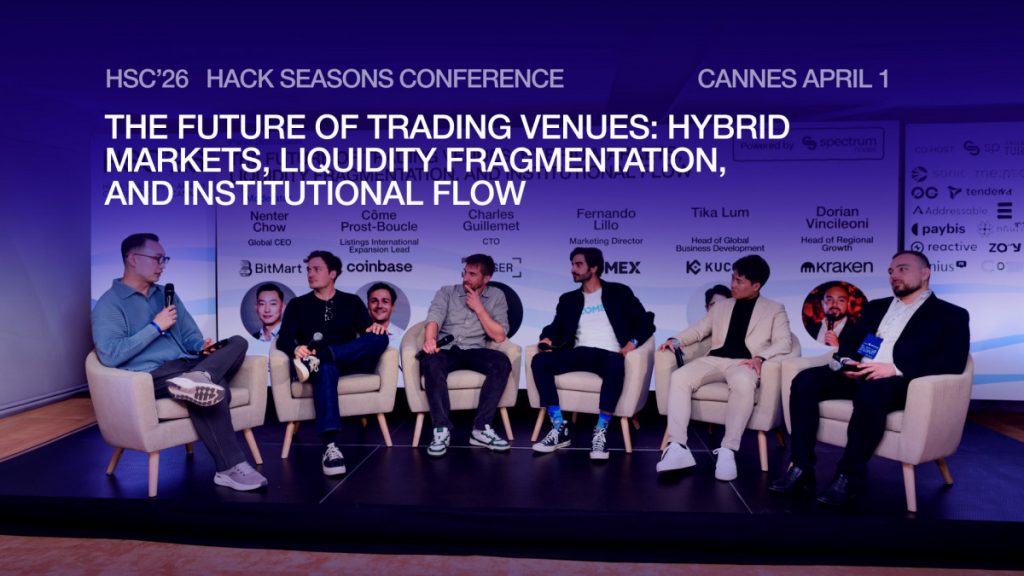
On April 1st, the Hack Seasons Conference in Cannes brought together industry leaders to explore the latest developments and opportunities in institutional digital assets.
Among the standout sessions was a panel titled “The Future of Trading Venues”, which examined how trading infrastructure is evolving to better serve both retail and institutional participants. Moderated by Nathan Chow, Global CEO of BitMart, the discussion featured Côme Prost-Boucle, Listings International Expansion Lead at Coinbase; Charles Guillemet, CTO at Ledger; Fernando Lillo, Marketing Director at Zoomex; Tika Lum, Head of Global Business Development at KuCoin; Dorian Vincileoni, Head of Regional Growth at Kraken; and George V, Strategic Partnership Lead at 0G.
The speakers unpacked the rise of hybrid market models, the persistent challenges of cross-venue liquidity fragmentation, and the increasingly important role of combined centralized and decentralized infrastructure in shaping institutional order flow.
Centralized Vs Onchain: Strengths And Trade-Offs
The panel opened with a broad but timely question: what are centralized exchanges still doing better than onchain venues, and where is onchain clearly ahead? From the start, the speakers framed the debate not as a simple “CEX versus DEX” rivalry, but as an ongoing redesign of market structure.
First, they agreed that centralized venues still lead in compliance, trust, deep liquidity, execution quality, risk management, and user experience. Several panelists pointed to regulated markets, custody, and institutional onboarding as areas where centralized platforms remain the practical default. Onchain, by contrast, was praised for what it does best: programmability, composability, transparency, self-sovereignty, and the ability to move value without handing assets to a third party.
Hybrid Markets, Fragmentation, And The Path To Convergence
The conversation then shifted toward hybrid models and liquidity fragmentation. Rather than asking whether trading should be entirely centralized or fully onchain, the speakers described a future where each layer is placed where it works best. Identity, compliance, custody, and onboarding were repeatedly described as functions that will likely remain centralized, while tokenization, payments, settlement, and other efficiency-driven components move onchain. That led naturally into a discussion of why hybrid products have been slower to ship: they are technically possible, but often too complex for retail users and still constrained by regulation.
From there, the panel moved to liquidity fragmentation and routing. The speakers traced fragmentation back to blockchain scalability limits, the rise of multiple chains, and the explosion of layer-2 solutions. Their view was that the market will eventually consolidate, with fewer winning chains and less wasted infrastructure. They also debated whether block space is still a compelling reason to launch new chains, with several panelists suggesting the real battle now is about use cases rather than infrastructure.
One of the most energetic sections focused on prediction markets. The panel explored whether these products are gambling, information markets, or something in between. Some described them as a more rational way to price uncertainty, while others emphasized their appeal to retail users who are drawn to narrative, speculation, and entertainment. Institutions, however, were consistently portrayed as approaching these markets with far more structure, analysis, and regulatory caution.
The discussion ultimately converged on a forward-looking theme: the fight for institutional flow. Looking five years ahead, speakers argued that successful venues will be those that integrate custody, trading, financing, compliance, and liquidity into a unified stack while bridging traditional finance and crypto-native markets. The closing takeaway was that the industry is leaving its experimental phase behind—credibility, infrastructure quality, and institutional trust are now the defining battlegrounds.
The post CEX Vs Onchain Is Over—The Real Fight Is For Institutional Flow And Market Control, Say Panelists At HSC Cannes appeared first on Metaverse Post.
Source: Mpost.io


0 Comments