

Crypto trading looks very different in 2026 than it did a few years ago. The market has matured, the tools have improved, and traders are asking sharper questions — not just “which coin should I buy?” but which platform actually fits how they trade, what it costs in full, and whether spot ownership or CFD exposure makes more sense for their situation.
The best crypto broker for one trader might be completely wrong for another. A beginner and a professional day trader have almost nothing in common in terms of what they need. Same goes for a forex trader moving into crypto versus someone who’s been trading Bitcoin natively for years. So instead of one recommendation, here’s an honest breakdown of who’s doing what well in 2026.
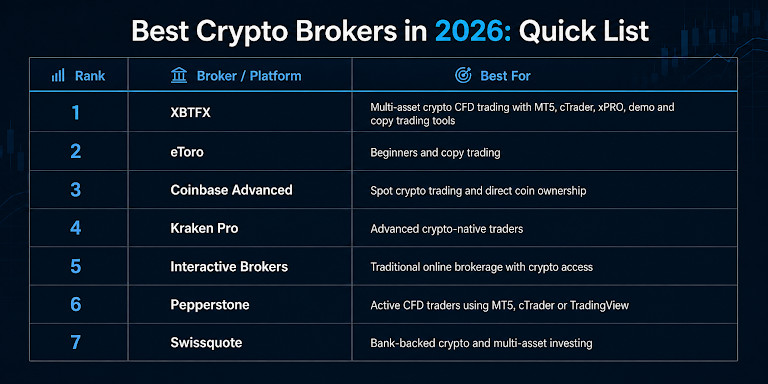
1. XBTFX — Strongest Pick for Multi-Asset Traders
If you’re coming from a forex or CFD background and want crypto to sit inside the same trading environment — same charts, same platforms, same account — XBTFX is the most natural fit. It runs MetaTrader 5, cTrader, and its own xPRO platform across forex, crypto CFDs, indices, commodities, and metals. You can hold balances in USD or crypto, which is a detail that matters more than it sounds when you’re actively trading.
Account structures cover Standard, ECN/Raw, Islamic, PAMM, and MAM setups, plus copy trading infrastructure. Beginners can start on a demo trading account. More experienced traders can run raw-spread accounts or manage multiple accounts simultaneously. It’s one of the few brokers where the setup genuinely scales with you.
One thing worth being clear about: if your goal is owning coins directly and moving them to a personal wallet, a spot exchange will serve you better. XBTFX is built for trading, not custody.
2. eToro — The Beginner’s Entry Point
eToro has built its reputation on accessibility, and that reputation holds up. The interface doesn’t intimidate new users, the onboarding is smooth, and the CopyTrader feature — which lets you mirror other investors’ portfolios automatically — gives beginners a way to observe real allocation decisions in real time.
That said, copy trading isn’t passive income. It still carries risk, and results vary. But as a way to learn how more experienced traders think about crypto and other markets, it’s genuinely useful. Advanced traders will hit the platform’s ceiling fairly quickly, but for the best crypto trading app experience at an entry level, eToro remains hard to beat.
3. Coinbase Advanced — For Traders Who Want the Actual Asset
Coinbase Advanced is where you go if you want to own crypto outright — not CFD exposure to its price, but the actual coins, with 500+ spot pairs, TradingView charting, API access, and a fee structure that rewards volume. It’s a meaningful step up from the standard Coinbase experience, and it makes sense for traders who want wallet access alongside their trading activity.
It’s not the right call if you’re looking for forex, multi-asset CFDs, or platforms like MT5 and cTrader. Those tools simply aren’t part of what Coinbase Advanced does.
4. Kraken Pro — Built for Experienced Crypto Traders
Kraken Pro doesn’t try to hold your hand, which is either a strength or a weakness depending on where you are in your trading journey. The interface is professional, the order tools go deep, and the underlying Kraken order book means liquidity holds up when markets get volatile. Margin trading is available in supported regions — useful for active traders, but the leverage cuts both ways in a market as volatile as crypto.
Beginners should probably start somewhere else and come back to Kraken Pro when they’re ready for it.
5. Interactive Brokers — Crypto Inside a Traditional Brokerage
IBKR isn’t a crypto-native platform, but that’s sort of the point. For investors who want Bitcoin or Ethereum exposure sitting alongside their stock and bond portfolio — without opening a separate account somewhere else — it solves a real problem. Commissions run 0.12%–0.18% of trade value with no added spreads or custody fees, and nano Bitcoin and nano Ether futures are available for eligible clients who want more sophisticated positioning tools.
Crypto selection varies by region, and the platform isn’t built for day trading crypto in the way dedicated platforms are. But as a traditional online broker with genuine crypto access, it’s a serious option.
6. Pepperstone — CFD Traders Who Know What They’re Doing
Pepperstone runs MT4, MT5, cTrader, and TradingView — which means traders who already have a CFD workflow can add crypto exposure without rebuilding anything. The technical analysis processes, the risk management habits, the order types — they all transfer. For that specific profile, it’s a smooth extension rather than a new learning curve.
Just worth reiterating: crypto CFDs and crypto ownership are different things. Pepperstone gives you the former.
7. Swissquote — The Bank-Backed Option
Swissquote occupies a particular niche: traders and investors who want crypto through an institution that also looks like a bank. Bitcoin, Ethereum, and a selection of other digital assets are available inside a broader financial ecosystem that includes traditional market access and conventional banking infrastructure. It appeals most to investors who want crypto as one component of a more conservative overall portfolio rather than as their primary trading activity.
What Actually Matters When Choosing
Spot vs CFDs — Do you want to own the asset or trade its price? Spot platforms give you the coin. CFD brokers give you exposure without custody. Both have legitimate use cases; the answer depends on your goals.
Platform fit — Traders coming from forex will find MT5 and cTrader much more natural than crypto-native interfaces. If you’ve spent time building indicator setups and automated crypto trading strategies on those platforms, staying in that environment makes sense.
Real cost, not headline cost — Spreads, overnight financing, withdrawal fees, conversion costs. The headline number rarely reflects what you actually pay per trade. Run the full calculation before committing.
Demo access — Genuinely underused. Whether you’re learning crypto trading strategies from scratch or testing a new platform, a demo account costs nothing and teaches you a lot about how execution actually behaves under real market conditions.
Regulation and jurisdiction — Crypto rules vary significantly by country, and product availability shifts accordingly. Check the legal entity and risk disclosures before depositing, not after.
Automation and AI tools — Interest in the AI crypto trading bot space is real and growing. These tools can help with scanning and rule-based execution, but they don’t eliminate risk. A misconfigured bot in a volatile market can cause serious damage. Use automation as a supplement, not a replacement for judgment.
Broker vs Exchange — The Short Version
Exchanges are for owning crypto. Brokers are for trading it — often across multiple markets, through professional platforms, with CFD structures and leverage. Neither is better in the abstract. One fits your situation or it doesn’t.
Where Does This Leave You?
For multi-asset traders who want crypto alongside forex, indices, and commodities on MT5 or cTrader, XBTFX is the clearest starting point. For beginners, eToro. For spot ownership, Coinbase Advanced or Kraken Pro depending on experience level. For traditional brokerage with crypto access, Interactive Brokers or Swissquote.
The broader market is shifting too. Morgan Stanley’s reported plan to bring crypto trading to E*Trade through Zerohash in 2026 is a signal worth paying attention to — the gap between crypto platforms and traditional online brokers is closing faster than most people expected.
Head to XBTFX.com to explore the platform, compare account types, and open a demo account before putting real capital to work.
The post Best Crypto Broker in 2026: Top Platforms for Trading Crypto and How to Choose One appeared first on Metaverse Post.
Source: Mpost.io
0 Comments