

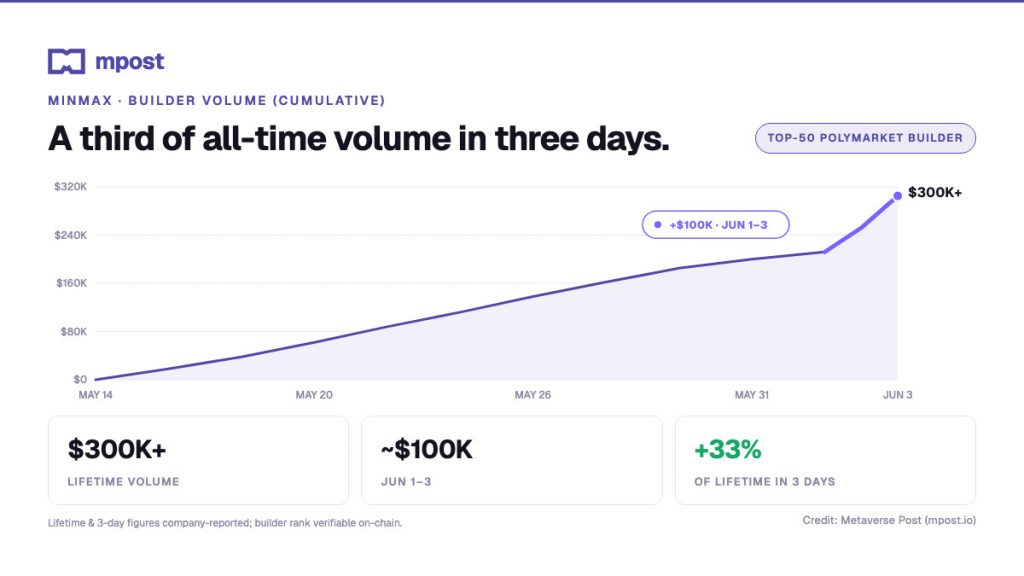
In the first three days of June, Minmax processed about $100,000 in trading volume. That is more than a third of everything the platform has done in its life, which now runs past $300,000. A weather-trading terminal it had just opened to the public did most of the work. None of that sounds like much in a market clearing tens of billions of dollars a month, and it isn’t. The number is small. Its shape is the part worth a look.
Almost everything written about Polymarket and Kalshi this year is about size. Record months. Ten-figure valuations. Brand-name trading firms opening event-contract desks. Minmax is a smaller story than any of that by dollars, and a more particular one by thesis. For eighteen months it has been building the part of the market nobody else bothered with: a professional trading terminal, a deep archive of order-book data, and an execution layer for AI agents. Equities grew all three a long time ago. Prediction markets never did.
The weather terminal is the first piece of it that ordinary users can actually touch. It’s also the clearest tell of where this is headed.
A single-screen workstation for trading event contracts on venues like Polymarket and Kalshi that unifies four things the native exchange apps leave separate: (1) a continuously recorded order-book data archive you can backtest against; (2) AI-derived signals computed on that data; (3) strategy authoring and backtesting; and (4) automated, low-latency execution. It is, roughly, what the Bloomberg Terminal, MetaTrader, and TradingView are to their markets, and what prediction markets do not yet have.
The Number That Matters Is The Slope, Not The Size
It’s worth being honest about that volume, because the honest version is the better story.
About $100,000 of a $300,000-plus lifetime total moved in a single early-June window. Call it a third of the company’s entire history, booked in three days. Those dollar figures come from Minmax itself. What you can check independently is where they land it: inside the top 50 Polymarket builders by volume, a spot it has held while the curve bent upward instead of flattening.
It is a small number on purpose, and it helps to see it against the backdrop. Prediction markets cleared a record $28.4 billion in combined volume in May 2026, Kalshi around $17 billion and Polymarket around $8 billion, up from under $5 billion as recently as last September. Take those headline billions as directional rather than gospel. Independent researchers have shown the volume is double-counted across dashboards, and one academic estimate put a sizable chunk of it, over the years, down to wash trading.
So, no, this is not a platform going toe to toe with Polymarket on volume, and reading it that way misses the point. Minmax is making a different wager: that the tooling around these markets is about to count for a lot more than it does today. The volume is just the engine ticking over while the bet plays out.
What Drove The Jump: A Terminal For Weather Markets
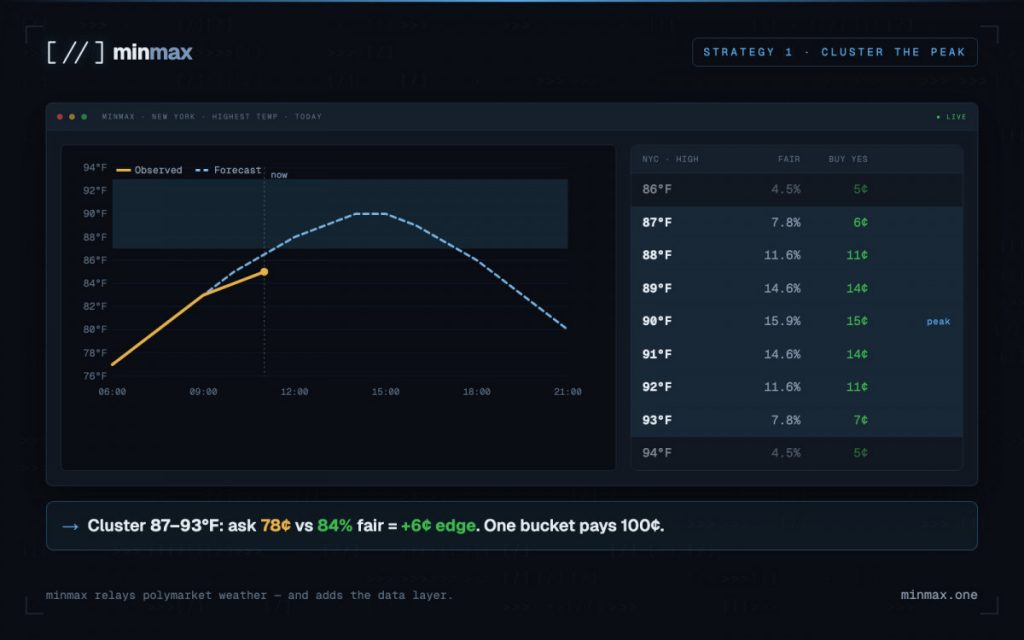
The June jump has a single source. At the start of the month Minmax opened its weather trading terminal to ordinary users, and within days it was the busiest thing on the platform.
If you have never traded Polymarket weather markets, they work like this. Each one is a yes/no bet on a city’s official daily high or low, something like “Will NYC’s high land at 89–90°F?” Buckets sit one or two degrees apart, priced in cents you can read straight off as probabilities. The winning bucket pays a dollar; the rest go to zero. Hundreds run at once, covering highs and lows for cities all over the world.
They are also one of the most quietly technical corners of the whole platform, because the price tells you almost nothing about how the thing actually settles. On polymarket.com, the New York market resolves off Weather Underground’s History tab for the LaGuardia station (KLGA), in whole degrees Fahrenheit. Settlement lands the next morning, usually around 8:00 a.m. ET. When the hourly METAR readings and the daily climate report disagree, it slips to a review near 11:00 a.m. And the details bite. An airport station can sit three to eight degrees off whatever the weather app on your phone says for downtown. The History tab counts hourly observations, not the 24-hour high. The U.S.-regulated Polymarket entity uses a different source again, the National Weather Service climate report, so the very same city on the very same day can settle to a different bucket depending on where you traded it. Most people learn all of this exactly once: the day a market settles against them.
This is the gap Minmax walked into. The native Polymarket weather screen hands you a price and an order book. It does not hand you the things that actually decide the outcome:
- the live observed temperature right now;
- the forecast curve running toward settlement;
- the model spread across forecasts;
- the daily peak window; and
- a countdown to the next official reading.
“The price was always there. The temperature wasn’t. We put the thing you’re actually betting on back on the same screen as the bet.”— MINMAX’S FOUNDERS
What Minmax runs is a live relay of those same Polymarket markets. It doesn’t operate them, hold your funds, or settle anything. It reads Polymarket’s exact settlement source and stacks the forecast curve, the live “now” reading, the peak window, the countdown to the next update and the full bucket ladder on top of the order book, all on one screen. The market still settles wherever it was always going to settle. You can just see the number that decides it sitting next to your position. That, more than anything, is why the surface caught on so fast. It also happens to be a compliment to Polymarket’s markets, not a swipe at them.
Prediction Markets Grew Up. The Tooling Didn’t.
Back away from temperature for a second and the weather terminal stops looking like a weather feature. The problem it fixes, traders flying blind to the data that settles their trade, has nothing to do with weather in particular. It runs through the entire market.
Watch how a serious Polymarket trader actually works in 2026, or just look at what comes up when someone searches “best Polymarket tools.” The native app is consumer software. It’s built for browsing markets and tapping a bet, not for running a desk. Under the hood, Polymarket is an on-chain central limit order book (CLOB) on Polygon, settled in USDC, with event outcomes resolved through UMA’s optimistic oracle. Developers hit it through the public CLOB and Gamma APIs, usually with the open-source py-clob-client library and a WebSocket feed for the book. One fact about that API quietly defines the whole category: it only returns the live state of a market. There is no historical endpoint. None. You cannot backtest a strategy against your own exchange’s past. A whole little industry has grown up just to patch that hole. Telonex sells 100 billion-plus data points. PolyHistorical records the full book every 300 milliseconds. pmxt ships hourly snapshots. When companies build a business out of selling you the data your own venue refuses to keep, the demand is obviously real, and obviously unmet.
So the trader bolts together a data feed, an analytics dashboard, a whale tracker and either a homemade bot or the native app, then bounces between all of them while the clock runs. Each tool is good at one slice and stops there.
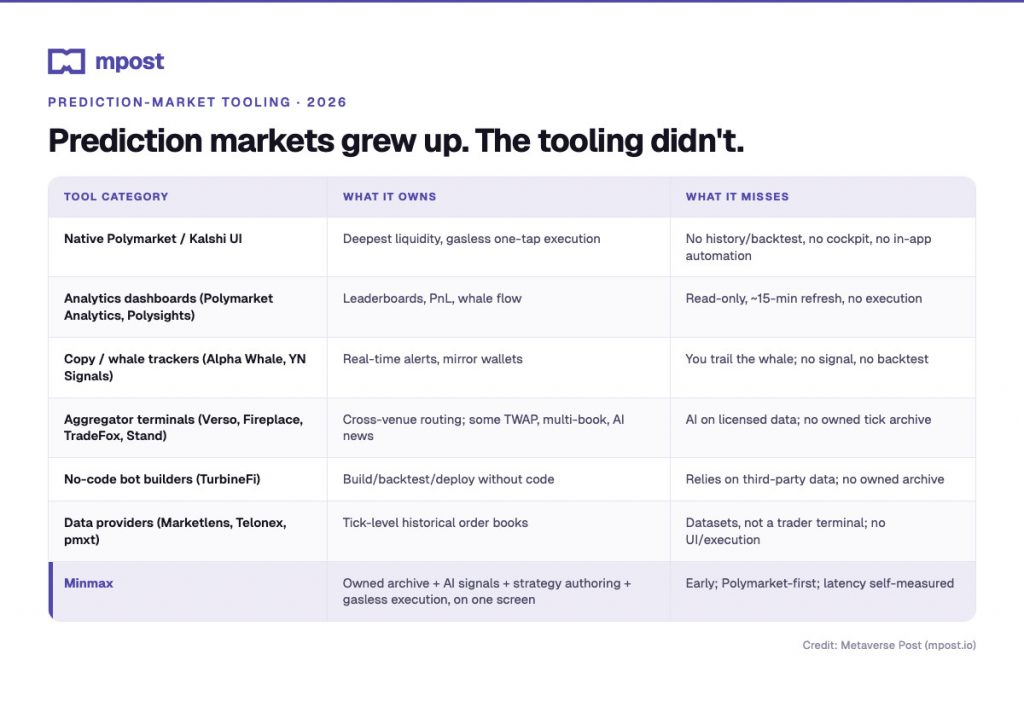
At a glance, what each tool category owns, and what it misses:
| TOOL CATEGORY | WHAT IT DOES WELL | WHAT IT’S MISSING |
|---|---|---|
| Native Polymarket / Kalshi UI | Deepest liquidity, gasless execution, one-tap betting | No history/backtest, no cross-market cockpit, no in-app automation, shallow charting |
| Analytics dashboards (Polymarket Analytics, Polysights) | Leaderboards, PnL, whale flow, AI summaries | Read-only, refresh every ~15 min, no execution (analyze here, trade there) |
| Copy / whale trackers (Alpha Whale, YN Signals) | Real-time alerts, mirror profitable wallets | You trail the whale; no original signal, no data layer, no backtest |
| Aggregator terminals (Verso, Fireplace, TradeFox, Stand) | Cross-venue routing and aggregation; some add TWAP/algo orders (TradeFox), multi-book depth (Stand’s Octobox), or an AI news feed (Verso) | AI reads someone else’s feed; no owned tick archive, no native strategy authoring underneath |
| No-code bot builders (TurbineFi) | Build, backtest, deploy bots without code | Relies on third-party data; no owned archive |
| Data providers (Marketlens, Telonex, pmxt) | Tick-level historical order books | Datasets for developers, not a trader-facing terminal; no UI, no execution |
| Minmax | Owned data archive + AI signals + strategy authoring + gasless agent execution, on one screen | Early; Polymarket-first, with Kalshi and sports next; latency self-measured |
Every other market solved this years ago, and traders already have names for the answer:
- Bloomberg Terminal — data, news, analytics, and increasingly agentic AI, in one place (equities’ gold standard, at ~$24k/yr);
- MetaTrader — scriptable Expert Advisors that automate and backtest a strategy (retail FX and futures);
- TradingView — charting where an alert can fire a trade; and
- tastytrade — a decade of backtesting baked into the interface (options).
There’s even an on-chain version of the story already. On Hyperliquid, the Insilico Terminal turned itself into the default pro cockpit by giving traders a free, serious interface on top of the venue’s native order book and making its money on flow. That is the clearest template anyone has for how a pro terminal takes over a young, fast-growing on-chain market. Prediction markets are simply the place it hasn’t happened yet.
And the timing isn’t hypothetical. The institutions are showing up by name. Through 2025 and 2026, reporting has put firms and investors tied to Susquehanna, Jump Trading, Citadel Securities, AQR and Galaxy Digital in and around event contracts, with prime-brokerage-style plumbing taking shape through the likes of Clear Street, Marex and Tradeweb, and Polymarket clearing its first block trade. People who trade at that level don’t stay happy with a one-tap consumer app for long. They arrive expecting a professional terminal. “Bloomberg Terminal for prediction markets” is already a crowded tagline, with several funded teams chasing it, but most of them lead with order routing or a news feed sitting on top of data they license. The layer underneath is the part almost nobody actually owns.
The Moat Is The Data, Not The Model
Ask the founders what actually makes Minmax hard to copy, and they don’t lead with the AI. They lead with the recording.
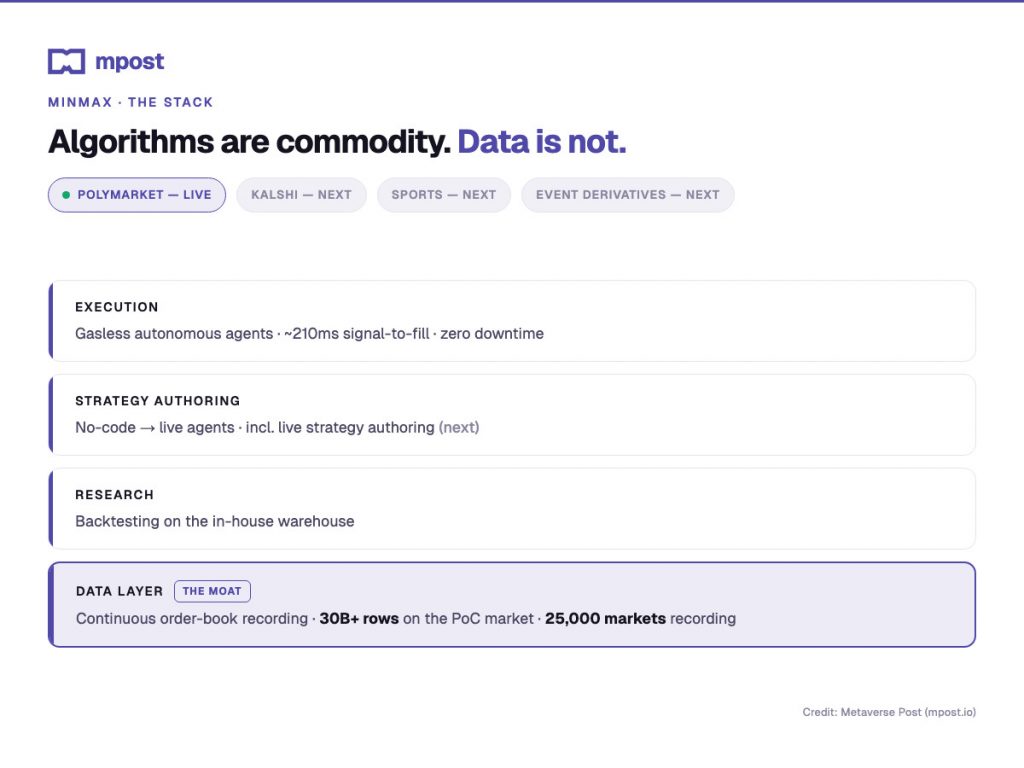
On its proof-of-concept market alone, the company says it has stored more than 30 billion rows of order-book data, and it’s recording roughly 25,000 other markets at the same time, getting the next venues ready before it trades a dollar on them. (Those numbers come from Minmax.) You can’t shortcut an archive like that. Order-book history isn’t something you backfill. You either had the pipeline running and capturing it in real time, or you didn’t. Anyone who decides today to come after them starts the clock at zero and waits.
“Algorithms are a commodity. Data is not. To replicate what we have, you don’t need a smarter model. You need a time machine.”— MINMAX’S FOUNDERS
That gap in Polymarket’s API, the one a dozen vendors are busy patching, is the same gap Minmax turned into a moat. The archive feeds the signals, the backtests, the replays. It’s the one piece a smarter model can’t summon after the fact. Rivals who plug in Telonex or PolyHistorical, or refresh a dashboard every fifteen minutes, are renting the exact layer Minmax owns outright.
The Obvious Objections
Two questions tend to come up, and both answer themselves once you follow the incentives.
Why won’t Polymarket or Kalshi just build this themselves? Because they’re exchanges. Their job is retail reach and one-tap volume, not a trader’s cockpit. The giveaway is that API again: still live-state only, still no history, years in. An exchange that wanted to own the pro layer would have shipped a historical feed long ago. They’ve left it open on purpose.
What stops a better-funded rival from cloning it? Not money. One of the strongest competitors is YC-backed; another raised a $1.5 million pre-seed. Both still lead with order routing or an AI news feed running on data they license from somebody else. You can close a round this quarter. You cannot close eighteen months of order-book history you never recorded. The model is copyable. The interface is copyable. The archive is not, because it only exists if you were capturing it, in real time, from day one.
None of which makes the moat permanent. If Polymarket or Kalshi shipped a deep historical API tomorrow, the “you can’t backfill” edge would shrink for anyone starting fresh. Minmax would still be the only one holding a continuous record of everything that traded before that day, but the gap would narrow. The whole thing rides on exchanges staying focused on the retail floor long enough for Minmax to build the pro layer first.
Why Bots Are Already Eating Prediction Markets
The timing is not an accident. Automated trading went mainstream in crypto this year; Kraken, Binance and OKX all shipped agent-trading tools in the last two quarters. Prediction markets are where the shift is easiest to see.
On Polymarket itself, AI agents already make up more than 30% of wallet activity, and one pass through the public leaderboard found bots holding 14 of the 20 most profitable wallets. The gap underneath that is brutal. Published estimates put consistently profitable humans at 7 to 13%. For agents the figure is closer to 37%, two to three times better. (One of them, Polystrat, built on the Olas/Autonolas protocol, ran more than 4,200 trades in its first month.) The caveat matters, so here it is in plain language: those are other people’s bots, not a return Minmax is promising anyone. And most of that bot profit, so far, comes from structural arbitrage rather than smarter forecasting. Minmax says its edge is data quality and speed, which is a different claim, and a claim only counts if the proof fits it.
The money is already chasing speed, too. By one analysis, arbitrageurs pulled roughly $40 million out of Polymarket on execution-timing alone between April 2024 and April 2025, none of it from forecasting better, all of it from filling faster. That is the world Minmax built its execution layer for. Its strategies run as autonomous agents out of gasless wallets, with a company-measured path from signal to fill of about 210 milliseconds. A human clicking between browser tabs takes several seconds. The agents hot-reload without redeploys and don’t go down. None of this is a loophole, either: Polymarket and Kalshi both support programmatic trading openly, and Polymarket has open-sourced its own agent framework.
The first agent Minmax ran in production trades Bitcoin five-minute markets, on purpose one of the tightest, fastest, most crowded corners of Polymarket. That market was never the product. It’s the proving ground.
“We picked the hardest market to fail in public. Five-minute Bitcoin punishes latency and bad data instantly. If the engine clears there, weather and sports are easier problems.”— MINMAX’S FOUNDERS
Further out, the plan is to put that power in the hands of people who will never write a line of Python: describe a strategy in plain English, and let an agent build it, test it against history and run it for you.
Polymarket Today, Kalshi And Sports Next
The roadmap is where this stops being about weather at all.
Weather is just one liquid, math-friendly corner of Polymarket. The loop behind it, record the book, dig the edge out of the data, execute through gasless agents, is meant to travel. Kalshi is next, and the case for it is hard to argue with. Kalshi did roughly $238 billion in volume in 2025, more than ten times the year before, and it now leads the category. Between them, Kalshi and Polymarket are something like 97.5% of all prediction-market volume, which makes “Polymarket today, Kalshi next” close to the whole map. Kalshi also exposes FIX connectivity, the same institutional order-entry rail equities desks have used for decades, which is exactly the kind of flow a pro terminal exists to serve. Minmax is disciplined about the bar here: it won’t call Kalshi a live trading venue until its archive there runs deep enough to make the same argument it makes about Polymarket now.
Past Kalshi is the bigger swing: sports. This is where the backing Minmax announced earlier in the year does its work, namely AI compute and infrastructure from ByteTrade and market access through a regulated sportsbook partner it still won’t name. Those two pieces are what make the strangest part of the roadmap possible. The company calls it live strategy authoring, a third way to trade a game. You watch the match, tune a quantitative strategy on the fly as it swings, and an agent works it against the live order book for you. It isn’t live yet. It’s flagged as next, not shipped. But it’s the purest version of the whole thesis: less like placing a bet, more like running a book against a market that won’t sit still.
The Terminal Is The Product
The June numbers are small, and Minmax knows they’re small. What they actually are is the first public evidence behind a contrarian bet. Prediction markets are already a $28 billion-a-month business. Bots already drive a third of the activity and hold 14 of the 20 best wallets. And the category still never grew the professional layer every grown-up market eventually grows. Minmax is betting that whoever holds the deepest continuous archive of the data is the one positioned to build it.
While rivals lead with order routing, or an AI news layer running on data they rent, Minmax’s angle is three things none of them holds at once: its own continuously recorded order-book archive; a measured path from signal to fill, and gasless agent execution on-chain. Plenty of teams will fight over the “Bloomberg terminal” line. The stack under it is the part that’s actually hard to copy.
Whether Minmax ends up the default terminal traders run prediction markets from is still an open question. The field is crowded and the company is young. But you can finally see the shape of what it’s building, and it’s a lot bigger than the weather. The terminal is live at minmax.one, under the line the team prints on everything it ships: minimize risk, maximize returns.
Key Numbers
| FIGURE | WHAT IT IS | SOURCE / BASIS |
|---|---|---|
| ~$28.4B | Record combined prediction-market monthly volume, May 2026 | Third-party reporting (Pew; The Block); directional, volume widely double-counted |
| $238B / +1,100% | Kalshi 2025 volume and YoY growth | Kalshi newsroom; CoinDesk |
| ~97.5% | Share of category volume held by Kalshi + Polymarket | Third-party reporting |
| ~$40M | Extracted from Polymarket on execution-timing arbitrage, Apr 2024–Apr 2025 | Arbitrage analysis; directional |
| 30%+ / 14 of 20 | AI-agent share of Polymarket wallet activity; bots among top-20 wallets | CoinDesk (Mar 2026); Finance Magnates |
| 7–13% vs ~37% | Consistently profitable humans vs. AI agents | CoinDesk; cited research |
| ~25% | Estimated share of Polymarket volume that was wash-traded (the hedge) | Columbia research; Paradigm |
| Top-50 · $300K+ / ~$100K | Minmax builder rank · lifetime / Jun 1–3 volume | Rank on-chain; dollar figures company-reported |
| 25,000 · 30B+ · ~210 ms | Markets recording · order-book rows (PoC) · signal-to-fill |
FREQUENTLY ASKED QUESTIONS
What is Minmax?
Minmax is a professional, AI-native trading platform for prediction markets, currently Polymarket, with Kalshi and sports markets on its roadmap. It pairs a continuously recorded order-book data archive with a one-screen trading terminal and autonomous, gasless trading agents, and is a top-50 Polymarket builder by volume.
How do Polymarket weather markets work?
They’re yes/no contracts on a city’s official daily high or low temperature, divided into adjacent one- to two-degree buckets priced in cents that behave like probabilities. The winning bucket settles at $1 and the rest at zero. Hundreds of temperature markets are active at any time, covering cities worldwide.
What data source settles Polymarket weather markets, and what time?
On polymarket.com, temperature markets resolve against Weather Underground’s History tab for the official airport station (for example, LaGuardia/KLGA for New York City), in whole degrees Fahrenheit, finalized the next morning, typically around 8:00 AM ET, with a delayed review near 11:00 AM ET if the hourly METAR and the daily climate report disagree. Minmax relays the polymarket.com markets and reads that same source.
Why does the same day’s high temperature settle differently on Kalshi vs Polymarket?
Because they read different official sources. Polymarket.com resolves against Weather Underground’s History tab (hourly METAR observations) for the airport station, while Kalshi and the U.S.-regulated Polymarket entity settle against the National Weather Service Climate (CLI) report. The CLI can differ by a degree, so the identical city, date, and station can resolve to different winning buckets across venues, which is exactly why seeing the settlement-source number matters.
Can you trade Polymarket through an API, and does it provide historical data?
Yes. Polymarket exposes a CLOB API (with a WebSocket order-book feed) for programmatic trading, and developers commonly use the open-source py-clob-client library. But the public API returns only live market state; it has no historical price or order-book endpoint, so you can’t backtest against your own venue’s past without recording the data yourself or buying it from a third party. Minmax solves this by continuously recording its own archive: more than 30 billion rows on its proof-of-concept market, with ~25,000 more markets under recording.
Is there a Bloomberg Terminal for prediction markets?
Not yet, though several teams are competing to build one. Most current tools own a single slice: analytics, copy-trading, order routing, or a data feed. Minmax’s bet is to converge an owned data archive, AI signals, no-code strategy authoring, and gasless agent execution into one terminal, the way Bloomberg, MetaTrader, and TradingView did for their markets.
Can AI agents trade prediction markets autonomously, and do they beat humans?
Yes. Both Polymarket and Kalshi support programmatic trading, and Polymarket has open-sourced an agent framework. On Polymarket, AI agents already account for more than 30% of wallet activity and 14 of the 20 most-profitable wallets are bots; by published estimates roughly 37% of agents are consistently profitable versus only 7–13% of human traders. That describes the market, not a guaranteed outcome for any individual trader.
Is automated or bot trading allowed on Polymarket?
Yes. Programmatic trading is officially supported, including gasless execution through Polymarket’s builder infrastructure. Minmax runs its strategies as autonomous agents from gasless wallets with a company-measured signal-to-fill path of about 210 milliseconds.
Is automated trading on Polymarket legal in the US?
Running a bot is permitted by the platform, but access and legality depend on jurisdiction: the offshore Polymarket exchange has historically restricted U.S. users, while a separate U.S.-regulated, CFTC-overseen entity now serves American traders under different rules and a different settlement source. Check which entity you’re using before deploying an agent. Minmax is a non-custodial relay and does not provide market access or legal advice.
What are the best Polymarket tools in 2026?
The Polymarket tooling stack in 2026 splits into categories, each strong at one job: the native Polymarket and Kalshi apps for liquidity and gasless execution; analytics dashboards (Polymarket Analytics, Polysights) for leaderboards and whale flow; copy/whale trackers (Alpha Whale, YN Signals) for mirroring wallets; aggregator terminals (Verso, TradeFox, Stand) for cross-venue routing; data providers (Marketlens, pmxt) for historical order books; and no-code bot builders. Minmax’s bet is to converge the owned data archive, AI signals, no-code strategy authoring, and gasless agent execution into a single professional terminal.
What makes Minmax different from other Polymarket tools?
Its continuously recorded, first-party order-book archive: more than 30 billion rows on its proof-of-concept market, with ~25,000 more markets under recording. Most competitors rent historical data or refresh on a ~15-minute cadence; Minmax owns the data its signals, backtests, and execution all depend on, which is the one piece that can’t be reconstructed after the fact.
Does Minmax support Kalshi and sports markets?
Not as live trading venues yet. Kalshi is the next venue on the roadmap, and sports markets are planned through a regulated sportsbook partner, supported by an AI-compute partnership with ByteTrade. A “live strategy authoring” mode for sports is in development and is explicitly not shipped.
In line with the Trust Project guidelines, please note that the information provided on this page is not intended to be and should not be interpreted as legal, tax, investment, financial, or any other form of advice. Prediction-market trading carries risk; nothing here is a guarantee of profit. Always do your own research.
The post How Minmax Is Building The Professional AI Trading Terminal Prediction Markets Still Lack In 2026 appeared first on Metaverse Post.
Source: Mpost.io


0 Comments